
Design with real products, real prices
Atrium is design software for furniture and interiors. Arrange parts and sub-assemblies freely, build pieces that look nothing like a box, make them dynamic, and take the very same design to price, sale and production with Bond.
Design anything
Arrange parts and sub-assemblies freely: boards of any outline, profiles along any path, sculpted parts from Rhino. Step out of the box shape - and if a part is missing, add it.
Real materials, market data
Ready materials, parts and assemblies from the Bond library and your company's catalog - with their own codes, thicknesses and prices.
Make it dynamic
Inputs, formulas and grips turn your design into a product that builds correctly at any size.
Sell, plan, build
With Bond: the BOM and price of every alternative, a Gantt of design, sales and production, and a page where the client reviews and approves the design - all from the same save.
An assistant that works in your document
Ask in plain words. The assistant uses the same commands as the interface, within your permissions, shows its plan before multi-step work, and every change can be undone. It runs through Bond, signed in with your company account.
Say what you want: the assistant shows its plan first and, once you approve, makes the change like a manual edit (undoable; saving stays with you).
The assistant in the docsBuilds and edits
Places and moves parts, sets materials, inputs and formulas, groups and arrays; creates complete materials, boards and 1D parts.
Checks your design
Parts going into each other or touching nothing, 1D/2D sizes outside the part's range, broken formulas, missing materials, exact duplicates.
Knows your company
Searches the company's catalog and projects, researches the web with sources, and remembers habits and company rules.
What sets Atrium apart
Products driven by spreadsheet formulas
25 functions (IF, CHOOSE, CEILING…), names in the formula and IDs underneath so renaming never breaks it, circular references caught, eight input kinds including material and part, per-instance inputs and grips you drag in the parent assembly.
Free design, not boxes
Boards of any outline, profiles swept along any path (arcs, splines), and sculpted Rhino/STEP parts in the same assembly, with live arrays along a path.
Profiles that cut their own joints
Where two 1D profiles meet, Atrium mitres or butts them by itself (T joints, arrow + V notch too), a closed frame round an opening is mitred all round, and the BOM length includes the end offsets.
Hardware that carries its own machining
A hinge or screw part brings its holes; they cut only the board under it and move with it, even inside a sub-assembly.
Exact geometry from Rhino
Ctrl+C in Rhino, Ctrl+V in Atrium brings solids and surfaces as exact NURBS (not meshes) in millimetres, and the Bond plugin's Send to Atrium button does the same.
Real material data
Colour and texture variants that carry their own price, and board thicknesses that each have their own code, weight and price.
Persian and English
Full Persian UI with Persian digits and Persian keyboard input in every number box (e.g. «۱۲ سانت»), bilingual item names.
Step out of the box
There is no shortage of cabinet software. Atrium is for anything made of parts: partitions, desks, counters, shelving, wall panelling, doors - and the one special piece only you have designed. Cabinets too - as one example among many.
Every task, the way Atrium does it
Recorded in Atrium itself. Each one links to its page in the docs.
Real captures, not mock-ups
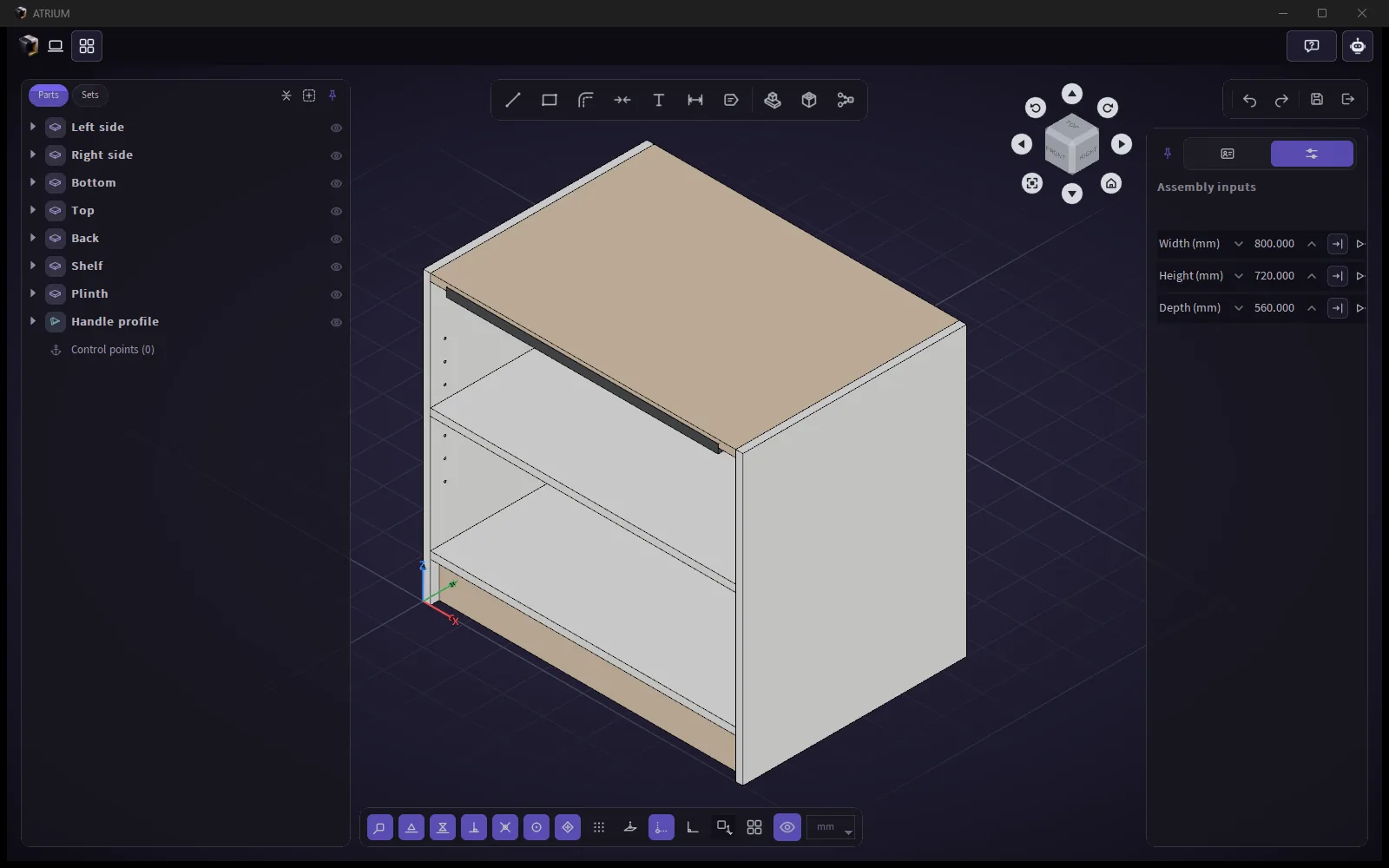
Captured straight from Atrium: the design tree and the assembly inputs; the same cabinet in Presentation shading; and the dashboard.
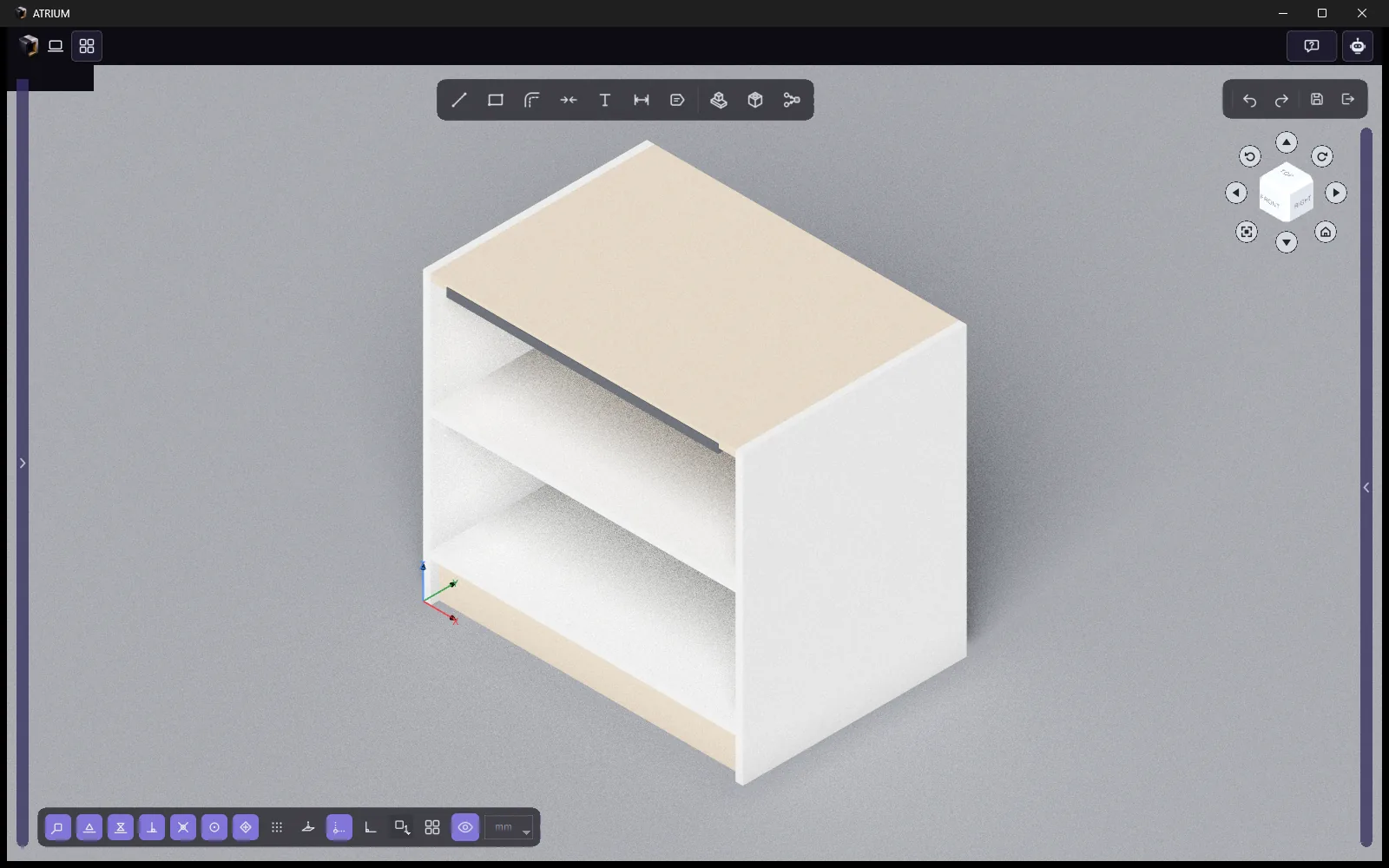
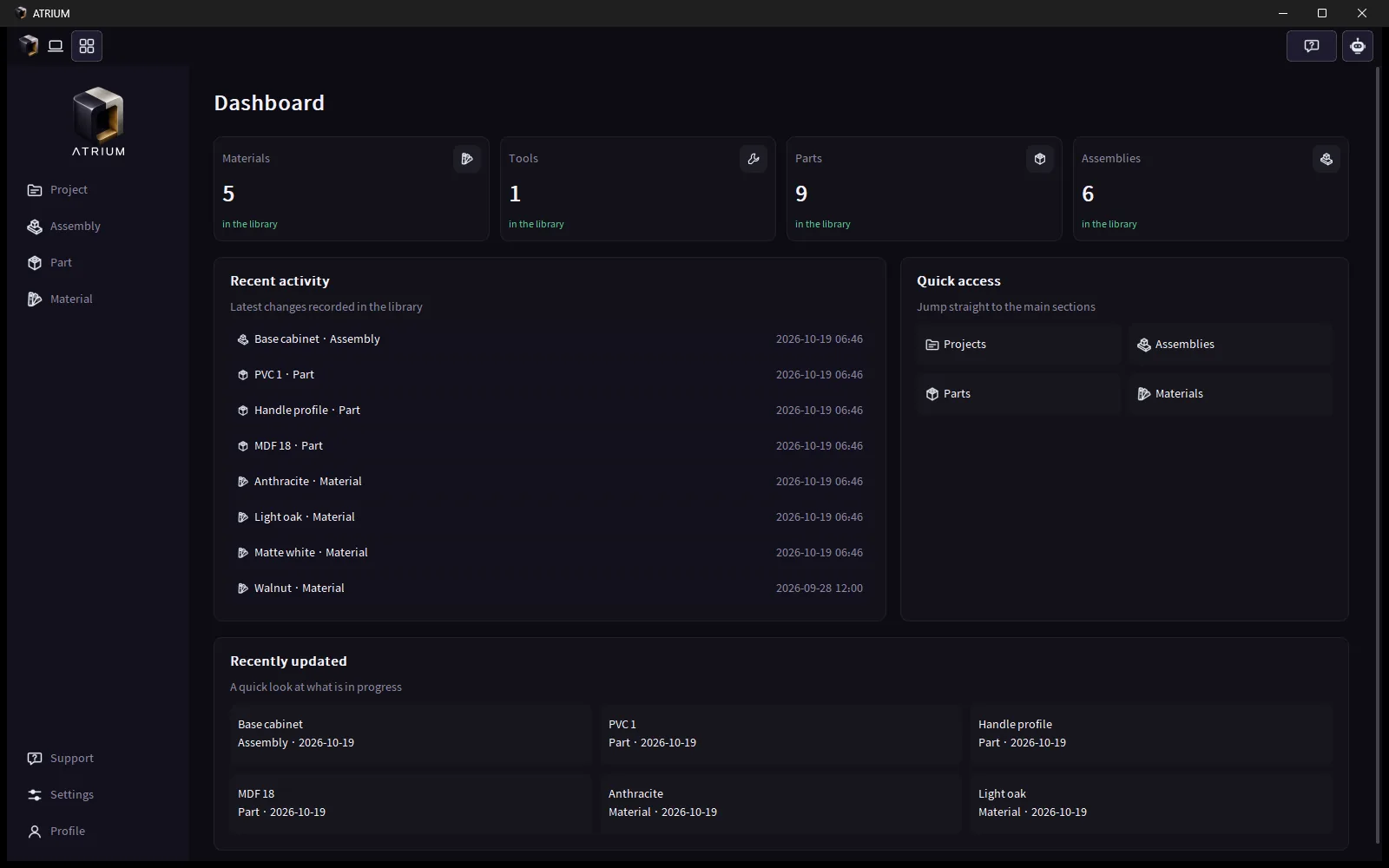
Design that reaches production, not just a render
Most interior design tools stop where the real work starts: the price, the order, the workshop. Atrium designs with the very part that gets built, from the start.
The right price, right now
The price is worked out from the parts and materials themselves, not estimated by hand - every save updates the numbers.
What was sold is what gets built
The design, the parts list and the production processes come from one source - nothing gets lost between the sale and the workshop.
Real products, real materials
Designers design with what is actually made - real colours, thicknesses and prices.
One design, three people relying on it
Companies & workshops
Build your products once, dynamic, and keep them in your company's Bond catalog; the price comes from the part and material prices.
- Parts, assemblies, materials with prices and codes
- Production processes on the parts
- Company account - no separate licence
Interior & freelance designers
Design pieces nobody else sells - with companies' real products and materials, so the price you give your client is a real one.
- Free-form design, not just boxes
- The ready-made Bond library
- 30-day free trial
The end client
Through the designer, sees a design that will really be built - with its price and an estimated delivery date.
- A clear price from the design
- An estimated delivery date
- No surprises at the workshop
Design, production, sales and the client - in one place
Atrium works on its own. Connected to Bond, design software, production management and customer follow-up share one account, one library and one project - so a piece goes from the first sketch to the client and the workshop without retyping anything.
Design
Parts, furniture and interiors in one program: free composition, inputs and formulas, processes, plans.
Save once - it is in Bond
The moment you save in Atrium, the project, edition and alternative are in Bond with their plans, parts list and prices - sales and production work from the same data.
Planner
A Gantt of design, design check, sales, financial, analysis and production - one row per person, in real working hours with holidays. Drag a bar to reschedule it or into another phase.
Client review & approval
Every plan with a 360° marker on each product, the assemblies, the parts list and renders, with the total price. The client asks for changes on the plan or on one product - or confirms. (Clients sign in to Bond today; a share link is planned.)
AR on the client's floor
Each product's 3D page opens in augmented reality on Android and iPhone, at true scale on the client's own floor.
AI rendering
Photoreal renders from the Bond Rhino plugin, kept per project and alternative in Bond's render gallery; the Bond assistant can make a picture in chat too.
Production data
The production phase in the planner, the parts list of every alternative, and time estimates per phase.
Shop, orders & instant quotes
Today every company has its catalog in Bond and can add from the shared library. Planned: a shop, orders, tenders for custom pieces and instant quotes from companies with auto-reply.
CRM
Planned: leads, clients and follow-ups next to the projects they become.
Design it. Price it. Build it.
Install Atrium and start with the ready-made Bond library - or read the docs first.